EOS Implementation Process: Why the Year-One Lift Levels Off (It Isn't the System)
Below the Waterline · Episode 10 · Blog
The system did not stop working. It worked exactly as far as it reaches.
The plateau after a real implementation is not the system failing. It is the company running with better structure while every new direction still routes through one person.
The first year of your EOS implementation process, revenue jumped. Then it went back to the same growth rate you had before, inside a company that now runs better than it ever has.
The system did not stop working. It worked exactly as far as it reaches, and there is a second zone it was never built to see.
In this episode you'll learn
- Why the year-one growth was real, what produced it, and why nobody should talk you out of counting it
- The two zones in every business, and which one an operating system can actually reach
- Why growth is navigation and not execution
- The difference between a GPS company and a Compass company
- One decision to make this week, and what to watch for in yourself while you wait
Watch or listen
Watch Episode 10 on YouTube · Listen to Episode 10 on Spotify
Why did revenue jump in the first year of EOS and then level off?
Think back to the first year after you put the system in.
The chart went on the wall, and for the first time somebody could point to it and say who was responsible for what. You had the seat conversations you had been avoiding. The weekly meeting started on time, with the same agenda, and issues that had floated around the building for too long got solved. You set quarterly priorities, and the company actually moved on them.
And revenue jumped. Not a rounding error. A real jump. By all accounts, it was a great year.
Then came year two, and year three. Everything still runs. The meetings start on time. The scorecard is mostly green. Your implementer says you are doing a great job, and you are. But the growth line is back to the same shape it had before you implemented anything. Not down. Just back.
Here is what that can look like from the inside: every new thing still starts with you. The market you have been circling, the pricing move, the right next hire. Nobody is stopping you, and nobody is arguing. They are waiting.
When you take a week off, nothing breaks. The system gave you that. And nothing new happens either, unless you make it happen.
So you reach for the reasonable explanations. Maybe it is the market. Maybe you need a stronger salesperson. Underneath those explanations, there is often a quieter sentence: it works, and it is still all on me.
What does a GPS company look like from the inside?
You get in a car, you know where you are going, you type it in, and the voice takes over. Turn left in 400 feet. Continue three miles. Take the next exit. You get there. You always get there.
Now do that drive fifty times with that voice. You still could not make it without the voice, because you never learned the roads. You learned to wait for the next turn.
That is your company. You set the destination two years ago, and you set it well. Your team is still waiting for you to call every turn.
This is the distinction Dori calls GPS vs. Compass. A GPS-driven organization relies on constant direction from the founder. A Compass-driven organization has a destination the founder set and a team that uses judgment to get there. In both kinds of company, the founder sets the direction. The difference is whether anyone else is allowed to make a turn.
“Your team needs you to set the direction. They don't need you to keep giving them turn-by-turn instructions.”
Setting the destination is your job in any company. Calling every turn is the habit that makes the company move at the speed of one person's attention.
What are the two zones in every business?
Every business has two zones, and an operating system lives in one of them.
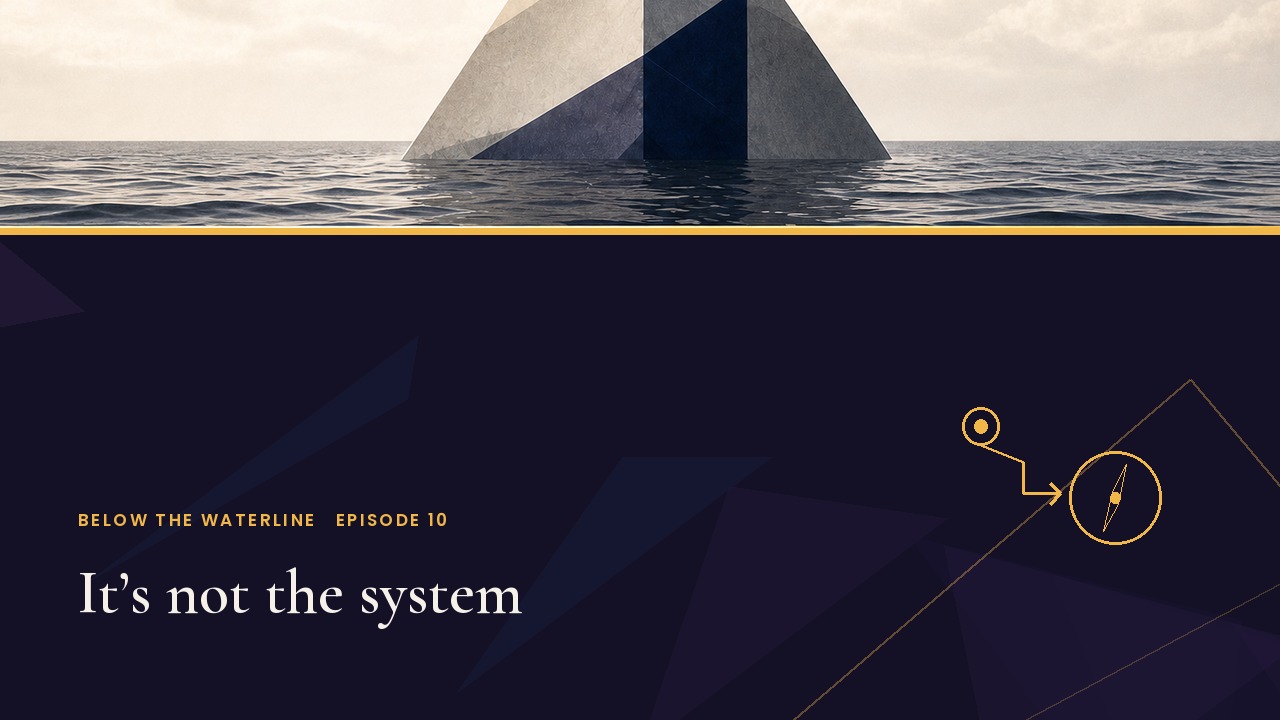
Above the waterline is structure: the chart, the seats, the numbers, the meeting rhythm, the priorities. This is where EOS lives, and it does important work. Nothing in this episode argues with the system.
Below the waterline is you. Not you as the seat on the chart. You underneath the chart. What you believe about control. What you believe your team can actually carry. Who you think you have to be for this to be safe.
No operating system goes there. A system can only organize what it can see. The first year was the visible half of your company finally getting structured. The growth was real.
Here is the tell: two years into a system built so you would not have to be the system, you are still the one giving directions. That is not necessarily about your capability or your team's. It usually signals something below the waterline, a belief about what happens when you do not tell people where to go.
It is not a character flaw, and it is not a missing skill. It may be the reason you were able to build the company in the first place, still running inside a company that has outgrown the need for it.
Why is growth navigation and not execution?
Execution is doing this year's work a little better than last year. After a real implementation, your team is excellent at that.
Growth is getting to a place the company has never been. There is no turn-by-turn for roads nobody has driven. Somebody has to read the territory as they go.
A Compass company is thirty people who know where the company is going, tacking toward it and making their own turns as conditions change. Thirty people reading the territory.
A GPS company can get there too. It just moves at the speed of the one voice calling the turns. Once the visible problems were solved, that one voice became the ceiling. Not your vision. Not your bandwidth. The system made the company execute your turns faster. It cannot change who calls them.
None of that is your fault. You were handed a system for the visible half of your company and told that was the company. You worked the half you were shown, and it worked. The plateau is not evidence that you did anything wrong. It is evidence that you finished what you could see.
“A GPS company can get there too. It just moves at the speed of the one voice calling the turns.”
Why does EOS never end, and what does that have to do with the plateau?
EOS is designed to be a living system. As you grow, you revisit every area of it: a new accountability chart, a new set of scorecard numbers, new quarterly priorities, and new annual plans. A company that is actually growing redraws its chart because it outgrew the last one.
That only happens in a company working both zones. Structure gives the team a place to navigate from. The work below the waterline is what lets them hold the compass instead of waiting for you. Put those two together and the growth comes back. The growth hands you the next chart, and the system you built starts to grow again.
Both zones, in tandem. That is why it sticks.
What happened when the direction stopped coming out of one head?
Years ago, Dori was brought in to reorganize a company. Twenty-two people, a balance sheet in the red, and no document anywhere that could say what those twenty-two people actually did.
The first move was the accountability chart. One of the things it showed was the money. There were no project budgets. The founder carried the entire financial picture in his head, deciding every week which project got attention, which vendor got paid, and what could wait.
The structural fix was obvious: project budgets. A number for every project that the person running it could navigate inside of without asking. A compass for money.
The second in command fought it, hard. On paper, he was arguing against his own relief.
One conversation made the reason clear. It was never about budgets. It was about what he would lose. Being the person who brought the cash answer to the founder every week was how he knew he mattered in the company. That could not resolve in a tactical conversation about budgets. It resolved below the waterline, in a conversation about how he would stay visible and included once budgets existed.
Once that was handled, the budgets landed. People stopped hiding problems and waiting for answers. They began coming together on solutions. When a quarterly goal fell behind, the question in the room became, “How do we resolve this together?” rather than, “Whose fault is this?”
Resistance to a structural fix is often a below-the-waterline conversation wearing a tactical disguise. Handle it in the right zone and the structure can land.
What should I do this week?
Not a program. One decision.
Find one thing on your list that you would normally give the turns on: a big account, a pricing question, a hire, whatever is sitting there with your name on it as the person who decides. Pick something real, not something safe.
Instead of the turns, give north. Tell the person who owns it where this has to end up, by when, and what good looks like at the finish line. Then say nothing about how. Where, by when, what good looks like. That is all.
Then wait.
Pay attention to the waiting. In the first day or two, something may come up: the urge to check, the certainty that it would be faster to say the thing, the story about what happens when they get it wrong. Do not take action on it and do not try to fix it. That is the second zone introducing itself.
Then watch what your team does. At some point somebody is going to make a turn you would not have made, and it is going to work. That may be the first new territory your company has found in years that you were not the one pointing at.
FAQ
Does this mean EOS stopped working?
No. The first-year growth was real, and it came from structural problems finally getting structure. A growing company keeps redrawing its chart and scorecard because it outgrows them. The plateau is what a working system can look like when only the visible zone is being worked.
What is the second zone?
The founder underneath the chart: what you believe about control, what you believe your team can carry, and who you think you have to be for the company to be safe. Dori calls it below the waterline.
Is my team just not ready to navigate?
Usually not. In a well-structured company, the reason every direction still comes from the founder is rarely a capability problem on either side. The place to look is what happens inside you when you do not call the turn.
What's the difference between a GPS company and a Compass company?
In both, the founder sets the destination. In a GPS company, every turn still comes from the founder. In a Compass company, the team knows north and makes its own turns as conditions change.
Where do I start?
Pick one decision this week that would normally get turn-by-turn instructions from you. Give the owner the destination, deadline, and definition of good. Then wait and notice what comes up.
Take the next step
If you heard your company in this episode, the Love/Great Trap assessment can help you name the pattern behind why you are still the one calling the turns. Take the free assessment: https://lovegreat.alignment-architecture.com?utm_source=dorietter&utm_medium=blog&utm_campaign=btw-ep10&utm_content=E10-BLOG
If what you find makes you want to talk it through, visit https://dorietter.com

