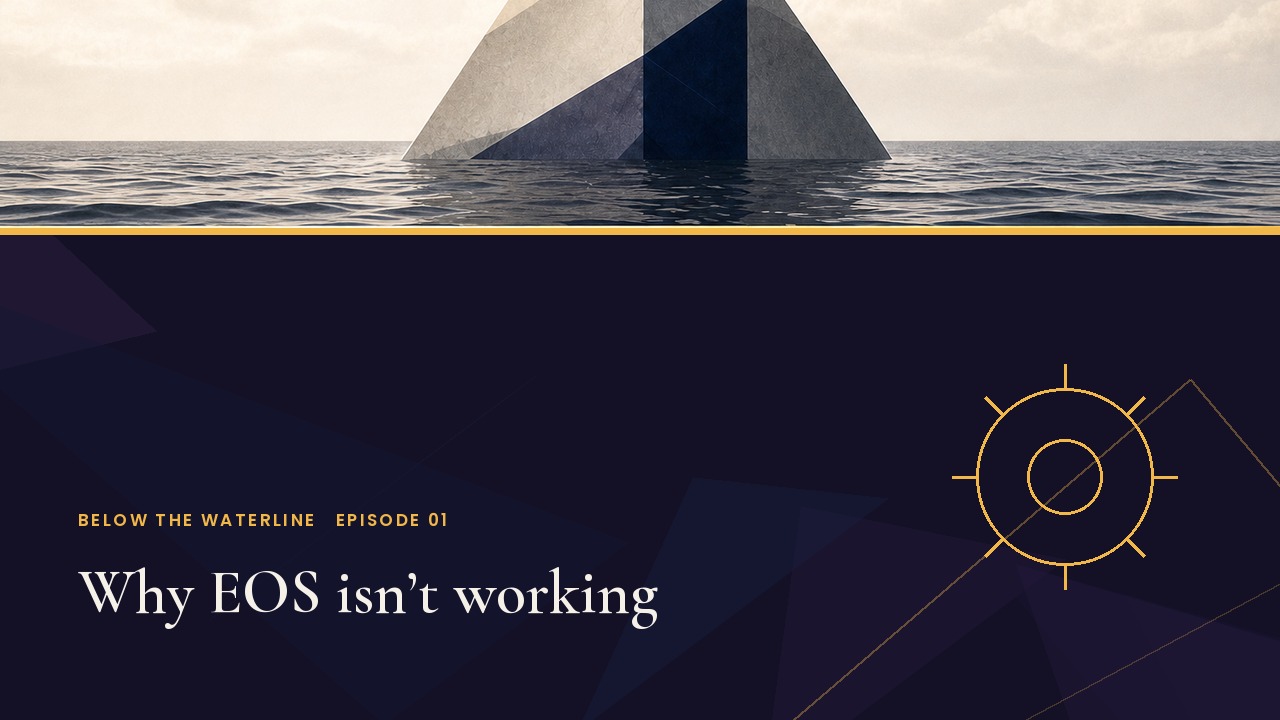
Why EOS Isn't Working: You Have an Alignment Problem, Not a Systems Problem
Alignment Architecture™ · Episode 01 · Blog
You don't have a systems problem. You have an alignment problem.
In this episode you'll learn: Why more process, a strong operator, and tighter meetings each worked for a season, and then slipped back · The vacation test that tells you whether you built a company or just relocated the bottleneck · The two beliefs that quietly run founder-dependent companies · Why your team believes your behavior over your accountability chart · The difference between GPS leadership and Compass leadership
Why does EOS stop working even when you run it perfectly?
Here's the pattern. A founder doing a few million in revenue brings in an operating system. They install the accountability chart. They run the scorecard. They hold the weekly meeting, with discipline. And 18 months later they sit across from me, almost embarrassed, and say: "I've done all of it. And I'm still the person every decision comes back to. What did I do wrong?"
The answer is nothing. They did the visible work perfectly. And that's exactly why it's so confusing. The reason isn't discipline and it isn't talent. An operating system organizes only one zone of the business, and the constraint lives in a different one.
The iceberg: your business runs in two zones
Picture an iceberg. Most of what you can see of a business sits above the waterline. The structure. The accountability chart. Who owns what. The scorecards, the meeting rhythm, the vision on the wall. It's visible, it's teachable, you can draw it on a whiteboard. This is where operating systems live, and where EOS lives. These systems work. EOS is genuinely good at bringing order to the chaos above the waterline, and if you've installed it, it's a great first move.
But the part of an iceberg above the water is never the part that sinks the ship. Below the waterline is the part that's much harder to put on a whiteboard. That part is you. Your identity. Your beliefs about how things have to be done. Your relationship to control. The quiet rules you've been operating with since the day you started.
"The part of an iceberg above the water is never the part that sinks the ship."
Two of the beliefs that keep you in every decision
Founders have a set of beliefs that keeps the system from sticking. They are the quiet rules that aren't written or spoken, but everyone follows. Here are a couple of the most common.
The first quiet rule sounds like this: if I don't touch it, it won't be done right. It's a belief, and there is no amount of above-the-waterline process to "fix" a belief. The structure says the decision belongs to the team. The belief says it won't be done right unless you check it. And your belief wins every time.
This is how it plays out. You give a team member real ownership: on paper, it's their call. Except when they make the call, it's not quite the call you would have made. Rather than seeing that it's valid and using this as a training opportunity, you step in and change it. It seems harmless, but your team is watching. They see your belief in action and learn to "check in" before making decisions, and you can't figure out why no one takes responsibility. It's because your people will always believe your behavior over an accountability chart.
The second belief feels like a virtue: no one cares about this the way I do. Sit with it. If no one cares the way you do, then no one can be trusted to carry it the way you do, which means you can never actually hand it over. That belief doesn't protect the company. It guarantees the company can never outgrow you.
"Your people will always believe your behavior over an accountability chart."
GPS leadership vs. Compass leadership
A GPS gives you turn-by-turn directions. Precise, and completely dependent. The second it goes out, you're lost, because you never learned the territory. A lot of operating systems accidentally build GPS organizations: everyone waiting for the next instruction. In a founder-led company, until you change this, you are the GPS. It feels like control. It's actually a leash.
A compass doesn't tell you every turn. It tells you which way is true north and trusts the person holding it to navigate. A Compass organization is full of people who know where the company is going and can make their own turns to get there. The shift from GPS to Compass isn't a systems upgrade you install. It's a shift below the waterline.
| GPS leadership | Compass leadership |
|---|---|
| Turn-by-turn direction | True north orientation |
| Team waits for instruction | Team navigates independently |
| Feels like control | Builds real capability |
| You are the dependency | You become scalable |
These beliefs aren't wrong. They're expired.
When I say the constraint is below the waterline, it can sound like I'm saying you're the problem. That's not it. The beliefs holding you back are the exact beliefs that built the company. "You touched it and made sure it was done right" is the reason the business exists. The caring is why you outworked everyone when all you had was a dream. So these beliefs aren't mistakes and they aren't wrong. They're just expired. What was an asset at the start becomes your ceiling.
Where EOS actually fits
EOS is not the enemy of this work. It's the foundation it stands on. The structure above the waterline is necessary, whether it's EOS, Gazelles, Scalable, or any of the myriad of structures out there. It's just not sufficient. The bottleneck was never the system. It was the founder's identity below the waterline. Fix the zone the system can't reach, and the system you already built starts producing the results it promised.
Your one exercise this week
Run a count. Every time a decision lands on your desk this week, before you go into solving mode, ask one question: is this above the waterline or below it?
Above means it's genuinely yours: your seat, your level, routed to you by the structure. Below means it landed with you because you pulled it here.
Don't change anything. Two columns, a tally mark each time. You can't change a pattern you can't see. Awareness comes before architecture.
Frequently asked questions
Why am I still the bottleneck after installing EOS?
Because EOS organizes the structure above the waterline. The reason decisions keep returning to you usually lives below the waterline, in beliefs like "it won't be done right unless I touch it." Structure can't reach a belief, so the pattern returns.
Is EOS a bad system?
No. EOS is genuinely good at organizing the above-the-waterline zone, and you should keep it. It's necessary but not sufficient on its own.
What's the difference between above and below the waterline?
Above is visible structure: accountability chart, scorecards, meeting rhythm. Below is identity, belief, and your relationship to control. Lasting change requires working both zones at once.
How do I find out if my problem is above or below the waterline?
Run a count for one week. Every time a decision lands on your desk, before you go into solving mode, ask one question: is this above the waterline or below it? Above means it is genuinely yours, your seat and your level, routed to you by the structure. Below means it landed with you because you pulled it here. Keep two columns, a tally mark each time, and change nothing yet. You cannot change a pattern you cannot see. Take the Waterline Check at dori.live/waterline. It's a short assessment that helps you see your real constraint.
Find out where your real constraint lives
Take the free Waterline Check. In a few minutes you'll know whether your real constraint is above the waterline, where you can design around it, or below it, where it takes belief and identity work. If you want to talk through what you find, you can book a conversation on the other side.
Take the free Waterline Check
About Dori Etter. Dori Etter is a founder advisor and creator of the Alignment Architecture™ methodology, the framework that addresses both the operational structure above the waterline and the founder's identity and beliefs below it. She works with growth-stage founders at $1M to $15M who are capable, busy, and still the bottleneck. She is the host of Below the Waterline, the leadership work no one else talks about. dorietter.com · LinkedIn · Instagram

